

The Connection Connection
Why strong ideas stall between communication and performance
You shared the message. You explained the expectation. You provided the training. You introduced the process.
So why has so little changed?
Because information alone rarely creates ownership.
The Connection Connection introduces a practical framework for understanding how people move from first encountering an idea to making it part of how they think, work, and lead.
Connection comes before change.
A forthcoming leadership book by Michael Lawrence, founder of Long Game Leadership.
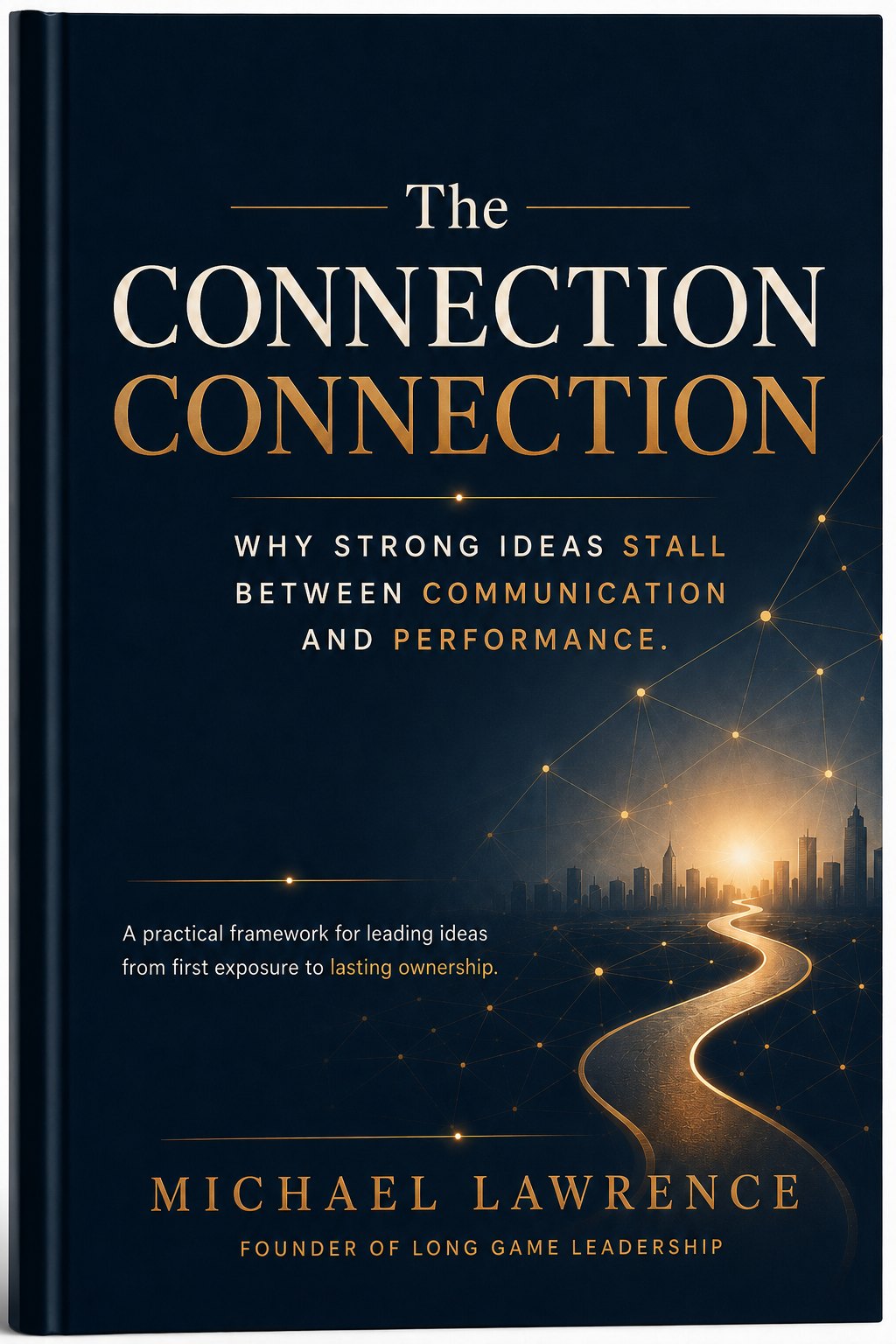
Draft cover — final design subject to change.
The Central Problem
Communication happened. Connection did not.
Organizations invest enormous time and energy communicating strategies, introducing initiatives, delivering training, and documenting expectations.
People attend. They listen. They acknowledge the message. They may even comply for a while.
But activity is different from ownership.
Many ideas fail to become part of how people actually work because leaders move too quickly from introduction to implementation. People are expected to adopt something before they have had the opportunity to understand it, observe it, experience it, and make it work in their own environment.
That is where connection breaks down.
Most leaders say they want high performance, but what they are actually building is high compliance.
About the Book
A more human way to understand change
The Connection Connection explores why some ideas take root while others quietly disappear.
The book helps leaders see the stages people naturally move through as they develop understanding, confidence, ownership, and commitment. It provides a practical way to recognize where progress has stalled and determine what people may need next.
This is bigger than communication. It is the journey from hearing to understanding, from watching to trying, and from temporary participation to lasting ownership.
Connection is the gateway from information to performance, and from process to practice.
The book is for leaders who want something deeper than attendance, agreement, or short-term compliance. It is for leaders who want ideas to become behavior, behavior to become practice, and practice to become part of the culture.
The Six Levels of Connection
How people move from introduction to ownership
The Six Levels of Connection provide a practical way to understand how people integrate ideas, expectations, skills, and change.
Exposure
People encounter the idea, expectation, opportunity, or change.
Awareness
People understand what it means, why it matters, and how it connects to them.
Observation
People see the behavior, decision, process, or practice demonstrated.
Experience
People engage, practice, experiment, and learn in their own context.
Adapt
People shape the approach to fit their role, team, and environment while preserving its purpose.
Adopt
The idea becomes part of how people think, decide, work, and lead.
The levels are more than a sequence. They are a diagnostic lens that helps leaders stop pushing harder and start responding to the connection that is actually present.
Why the Framework Matters
Find the gap before choosing the solution
When progress stalls, leaders often communicate more, increase accountability, add training, or tighten control. Those actions may create movement, but they may also address the wrong problem.
What level of connection is actually present right now?
That question helps leaders determine whether people need a clearer introduction, more personal relevance, a visible example, a safe opportunity to practice, permission to adapt, or reinforcement that supports lasting adoption.
Who the Book Is For
For leaders responsible for turning ideas into action
- 01
Executives leading strategy and transformation
- 02
Managers building commitment and accountability
- 03
HR, talent, learning, and organizational development leaders
- 04
Change leaders introducing new systems or expectations
- 05
Anyone tired of watching good initiatives begin loudly and disappear quietly
Free Reader Resource
Where Is Connection Breaking Down?
A Six Levels Reflection Guide for Leaders
Before communicating again, introducing another solution, or questioning people's commitment, take a closer look at the connection that currently exists.
Use this practical guide to assess a real leadership or organizational challenge, identify where connection may be breaking down, separate evidence from assumption, and choose a practical next move.
Enter your name and email to access the free guide.

About the Author
Michael Lawrence
Michael Lawrence is the founder of Long Game Leadership and a leadership, learning, and organizational capability strategist with more than 20 years of experience.
His work sits at the intersection of what organizations are trying to accomplish, what leaders are asking people to do, and what people must understand and experience to make that work real.
Throughout his career, Michael has seen organizations invest in communication, training, process, and leadership initiatives while overlooking the human journey required for those efforts to take hold. That observation became the foundation of The Connection Connection and the Six Levels of Connection.
Michael's approach is direct, practical, and human. He helps leaders move beyond activity and compliance to build clarity, capability, ownership, and sustainable performance.
Stay Informed
Follow the journey from manuscript to release
The Connection Connection is currently being developed for publication.
Join the book list for publication updates, new articles and excerpts, practical leadership resources, event invitations, and early access to tools based on the Six Levels of Connection.
Speaking and Workshops
Bring The Connection Connection to your organization
The ideas in the book can become a shared language for leaders, teams, and organizations through keynotes, workshops, leadership conversations, and change-adoption sessions.
Explore Speaking and WorkshopsKeynote speaking
Leadership workshops
Team facilitation
Change-adoption sessions
The Long Game
Real change begins before adoption
It begins when people encounter an idea. It deepens when they understand why it matters. It grows when they see it in action. It becomes personal when they experience it. It gains ownership when they adapt it. It becomes sustainable when they adopt it.
Lead through connection.